Samsung 50U for Electric Aviation and Space Applications: A Battery Engineer's Guide Beyond the Datasheet

Updated: May 27

1 Samsung 50U Cell Overview and Positioning
The Samsung 50U is a 5.0 Ah high-performance lithium-ion cylindrical cell in the 21700 form factor, manufactured by Samsung SDI. As a tier 1 cell from one of the world's leading battery manufacturers, the 50U targets electric aviation and eVTOL propulsion systems where pack mass, power delivery, and thermal behaviour are simultaneously constrained. Its tier 1 manufacturing standard and established supply chain reliability make it a credible candidate for satellite and space power systems, where cell reliability and long-term performance consistency are non-negotiable.
From the manufacturer's specification, the 50U delivers a nominal capacity of 5,000 mAh, 18.0 Wh of energy, and a nominal voltage of 3.6 V. The cell uses a Ni-based positive electrode chemistry and supports a maximum continuous discharge current of 60 A (12C) with an 80°C thermal cut-off, a maximum continuous charge current of 15 A (3C), and a discharge cut-off voltage of 2.5 V. Maximum cell dimensions are 21.4 mm diameter by 70.62 mm height, with a maximum mass of 72 g.
To ensure consistency across manufacturers, The Voltt reports energy density based on maximum cell mass. Using the maximum specified mass of 72 g, this yields a minimum gravimetric energy density of approximately 250 Wh/kg. At the continuous discharge rating of 12C, this corresponds to a gravimetric power density of 3,000 W/kg, positioning the 50U among the stronger combined energy-and-power performers within the 21700 format in The Voltt cell library.

For electric aviation engineers, this combination is directly relevant: the cell offers competitive energy storage alongside a discharge rate envelope that can accommodate the high-current demands of take-off and climb without compromising cruise-phase energy availability. These specifications raise practical questions that the datasheet alone does not resolve:
How does voltage hold under the sustained high current load during take-off and landing?
How much capacity remains accessible under realistic constant power loading as cell voltage declines through discharge?
At what point does thermal behaviour become the binding constraint, and how does the cell perform across the mid-SoC cruise window where most flight time is spent?
At what SoC does transient pulse capability begin to deteriorate?
These questions require validated simulation under mission-representative conditions to answer with confidence. The sections below apply lab-validated electrical models within The Voltt to evaluate rate-dependent discharge, sustained power loading, pulse demand, and a representative eVTOL mission duty cycle, defining the cell's practical operating envelope across the conditions most relevant to electric aviation programmes.
The Importance of Accurate Cell Selection
Choosing the right cell is one of the most important decisions in battery system design. It directly influences pack mass, thermal architecture, discharge limits, and overall system performance. In electric aviation platforms such as eVTOL aircraft, where both energy storage and high power delivery are tightly constrained by safety and weight requirements, small differences at the cell level can translate into significant system-level impacts.
While manufacturer datasheets provide baseline specifications such as capacity, voltage limits, and maximum current ratings, they rarely offer enough detail for confident system design. Information on temperature rise under sustained load, voltage behaviour across the discharge window, and performance under realistic cooling conditions is often missing or based on idealised test setups.
As a result, engineering teams face three recurring challenges in the traditional cell selection process:
Inconsistent benchmarking: Manufacturer data is rarely reported under identical test conditions, making direct comparisons difficult. Engineers must also validate whether published performance claims translate to their specific application and mission profile.
High testing overhead: Accurate characterisation and validation require specialised cyclers, environmental chambers, safety systems, and instrumentation. For many teams, this represents significant capital and time investment before meaningful conclusions can be drawn.
Delayed development cycles: Cell sourcing, shipping, and full qualification testing can add weeks or months to development timelines, particularly when down-selection involves multiple candidates.
To address this, this white paper applies lab-validated electrical models in The Voltt to evaluate the Samsung 50U under application-relevant conditions. By simulating rate-dependent discharge, sustained power loading, pulse demand, and eVTOL mission cycles, we move beyond static datasheet values and define the cell's practical operating envelope for electric aviation platforms under realistic scenarios.
2 Samsung 50U Cell Performance Characterisation
2.1 Samsung 50U Constant Current Test - Capacity Check

To verify the nominal capacity of the Samsung 50U, a capacity check was conducted at 25°C under controlled laboratory conditions. The cell was discharged at C/30 to minimise polarisation and establish baseline accessible capacity.
At C/30, the cell delivered a measured capacity of 5.09 Ah, exceeding the manufacturer's minimum specified capacity of 4.90 Ah. This confirms strong baseline energy availability and indicates the cell sits comfortably above the lower bound of cell-to-cell variation. It is worth noting that the minimum specified capacity is generally conservative and represents the lower bound of expected cell-to-cell variation across the production population. The voltage profile is characteristic of Ni-based positive electrode chemistry, showing a continuously sloping discharge curve without the flat plateau regions associated with LFP chemistries. Voltage begins at approximately 4.19 V and declines progressively through discharge, with a more pronounced drop below 3.2 V as the cell approaches the 2.5 V cut-off.
For electric aviation applications, this baseline capacity result establishes the energy available under low-rate conditions. Subsequent sections evaluate how much of this capacity remains accessible as discharge rate and power demand increase to propulsion-relevant levels.
2.2 Samsung 50U Constant C-rate Simulation
To assess how the Samsung 50U responds to increasing discharge demand across its operating range, constant current discharges were simulated at 1C, 3C, 5C, 8C, and 12C under controlled thermal conditions. This sweep covers the range from moderate cruise-representative loads through to the manufacturer's maximum continuous discharge rating, providing a clear view of voltage behaviour, capacity retention, and thermal response across the full rate envelope.

At 1C and 3C, curves remain closely grouped with polarisation modest and voltage staying above 3.6 V through the majority of discharge, and capacity retention is strong at these rates: 5.03 Ah at 1C (~103% capacity retention of the 4.90 Ah minimum specified capacity) and 4.96 Ah at 3C (~101% capacity retention). At 5C, separation from the lower rates becomes more pronounced, though the cell continues to deliver near-full capacity at 4.88 Ah (~100% capacity retention), confirming that the cell accesses essentially its full rated energy across the lower three rates. At 8C and 12C, initial polarisation is significant, with voltage dropping sharply at the onset of discharge before partially recovering as the cell warms and internal resistance decreases. At 8C, delivered capacity falls to 4.67 Ah (approximately 95%), with termination driven by the 80°C thermal cut-off rather than voltage. At 12C, the thermal cut-off is reached significantly earlier, limiting delivered capacity to 3.35 Ah (approximately 68%). These results confirm that above 5C, thermal constraint rather than electrical depletion becomes the binding limitation on discharge.

Power output at each rate reflects the combined effect of current and declining voltage through discharge. At 1C, power remains low and stable throughout, finishing at approximately 18 W per cell. At 3C and 5C, power output rises steadily as the product of moderate current and a broadly maintained voltage window, reaching approximately 57 W and 97 W respectively at the start of discharge. At 8C, initial power approaches 155 W before declining as voltage falls and thermal cut-off approaches. At 12C, peak power exceeds 220 W in the early discharge phase but falls sharply as the cell heats and polarisation increases, with thermal termination before full capacity is reached.
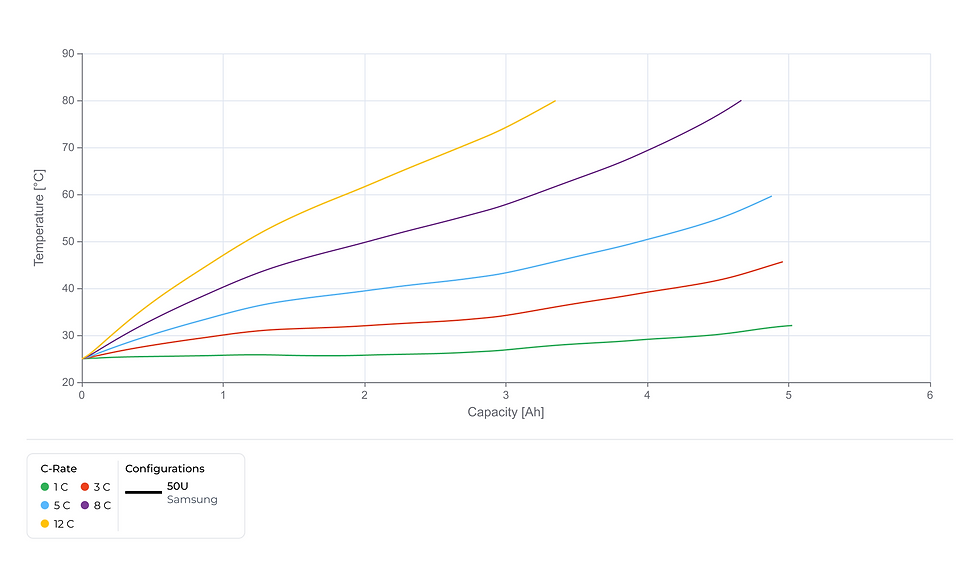
At 1C, peak temperature reaches approximately 32°C, representing a 7°C rise from the 25°C starting condition. At 3C, peak temperature rises to approximately 46°C, and at 5C to approximately 60°C, both of which are within manageable bounds for a moderate forced air-cooled system. At 8C, temperature rises steeply and reaches the 80°C thermal cut-off before the electrical capacity is exhausted, confirming that sustained operation at this rate is thermally rather than electrically limited. At 12C, the thermal cut-off is reached much earlier in the discharge, with temperature rising rapidly from the onset of discharge and limiting useful capacity to approximately 68% of the minimum rated value. For eVTOL applications, these results indicate that sustained per-cell currents above approximately 5C require active thermal management beyond moderate forced air cooling, and that 8C and 12C operation should be treated as short-duration or transient conditions rather than continuous discharge rates.
Summary of Performance Metrics (Simulation)

Simulations were performed at C-rates of 1C, 3C, 5C, 8C, and 12C starting from:
Initial SoC: 100%
Initial Cell Temperature: 25°C
Heat Transfer Coefficient: 50 W/m²K (representing moderate forced air cooling)
Why This Matters
The constant C-rate results define the thermal operating envelope of the Samsung 50U clearly. Up to 5C, the cell delivers strong capacity retention and manageable thermal rise under moderate forced air cooling, confirming suitability for the sustained mid-power phases that dominate eVTOL mission profiles.
At 3C, the approximately 46°C peak temperature and near-full capacity delivery indicate that climb-phase current demands in this range are well within the cell's electrical capability, though thermal management should be sized accordingly for repeated cycles. At the low end of the rate envelope, the near-identical capacity delivery at 1C and the minimal 7°C temperature rise confirm the 50U is equally well suited to satellite and space applications, where discharge rates are typically well below 1C and thermal stress is a primary reliability concern. At 5C, the approximately 60°C peak temperature confirms that active thermal management is advisable for sustained operation at this rate.
Above 5C, thermal constraint becomes the primary design consideration. At 8C and 12C, the 80°C thermal cut-off is reached before the electrical capacity is exhausted, confirming that sustained high-rate discharge at these levels is not viable under moderate forced air cooling alone. For take-off and landing phases where peak current demands approach these rates, pack configurations that distribute current across a greater number of parallel strings are necessary to maintain per-cell current within thermally safe bounds. These results provide the quantitative foundation for defining per-cell current limits and cooling strategy requirements in eVTOL battery system design.
3 Samsung 50U Simulation and Mission Performance Analysis
3.1 Samsung 50U Constant Power Simulation
While constant current testing establishes rate-dependent behaviour under fixed discharge currents, constant power discharge captures a more representative operating condition for eVTOL propulsion systems, where motor controllers draw current dynamically to maintain thrust as cell voltage declines during discharge. Under constant power, current is not fixed but rises continuously as voltage falls, amplifying the electrical and thermal stress toward the end of discharge in a way that fixed-current testing does not reveal. To evaluate this behaviour, the Samsung 50U was simulated at five power levels: 10 W, 25 W, 50 W, 100 W, and 150 W per cell.

At 10 W, 25 W and 50W, voltage remains relatively well supported across the full discharge window, staying above 3.6 V through the majority of the mid-discharge region before declining more steeply toward the 2.5 V cut-off. At 100 W, the profile is polarized further, with voltage sitting around 3.65 V at the start of discharge and declining progressively to the cut-off at approximately 4.76 Ah. At 150 W, the combined effect of high current drives voltage down more sharply, with rising resistive losses causing termination occurring at approximately 4.16 Ah due to the 80°C thermal cut-off being reached before cell is completely depleted.

Under constant power, current is not fixed but rises continuously as voltage declines, a behaviour invisible in C-rate sweeps and directly relevant to propulsion system design. At 10 W, 25 W, and 50 W, current remains well within the continuous rating throughout discharge, reaching peak values of approximately 4 A, 10 A, and 20 A respectively, with the cell delivering near-full capacity across all three levels (103%, 102%, and 101% of the 4.90 Ah minimum). At 100 W, peak current reaches approximately 40 A toward end of discharge, at the boundary of the no-temperature-cut continuous rating, with capacity retention still strong at approximately 97%. At 150 W, peak current reaches approximately 54.6 A, exceeding the continuous rating for a significant portion of the discharge, and the 80°C thermal cut-off is reached at approximately 4.16 Ah (approximately 85% retention) before the cell can be fully depleted. For sustained operation at this power level, active thermal management beyond moderate forced air cooling would be required to extend the discharge window and prevent early thermal termination.

Thermal behaviour scales clearly with power level across the sweep. At 10 W and 25 W, peak temperatures reach approximately 30°C and 37°C respectively, representing modest rises from the 25°C starting condition and confirming operation well within safe thermal margins across both loads. At 50 W, peak temperature reaches approximately 48°C, manageable under moderate forced air cooling for single discharge cycles though warranting consideration in repeated or back-to-back mission scenarios. At 100 W, peak temperature reaches approximately 70°C, representing a substantial thermal load that approaches the cut-off threshold and requires active thermal management for sustained or repeated operation at this level.
At 150 W, the 80°C thermal cut-off is reached before full electrical discharge, terminating the simulation at approximately 4.16 Ah. The progressively steepening temperature curves at higher power levels reflect the compounding effect of rising current on resistive heat generation as voltage falls through discharge, a dynamic that constant current testing at equivalent average currents would underestimate.
Summary of Performance Metrics (Simulation)

Operating Conditions
Initial SoC: 100%
Initial Cell Temperature: 25°C
Ambient Temperature: 25°C
Heat Transfer Coefficient: 50 W/m²K (representing moderate air forced cooling)
Minimum Voltage: 2.5 V
Maximum Temperature: 80°C
Why This Matters
Constant power simulation provides an application-relevant view of the Samsung 50U's capability for eVTOL propulsion design, where power rather than current defines system requirements across flight phases. The results show that the 50U maintains strong capacity retention and controlled thermal behaviour across a wide power range. At 10 W through 50 W per cell, covering the cruise and approach phases of a typical eVTOL mission, the cell delivers near-full capacity with modest thermal load, confirming its suitability for sustained cruise operation under moderate forced air cooling.
At 100 W per cell, capacity retention remains at approximately 97% and peak temperature reaches 70°C, remaining below the thermal cut-off and demonstrating the 50U's ability to sustain high power output across the full discharge window. At 150 W per cell, the 80°C thermal cut-off is reached before full electrical depletion, highlighting the importance of pack parallelisation and active thermal management for the most demanding flight phases such as take-off and landing.
These findings provide a clear framework for system designers to:
Define continuous and peak per-cell power limits across flight phases
Size parallel strings for current sharing under high-demand conditions
Design cooling systems to maintain thermal margin during peak load
Ultimately, constant power simulation reveals not just how much power the cell can deliver, but how sustainably it can deliver it within real mission constraints.
3.2 Samsung 50U Mission Profile Pack Simulation
While constant current and constant power simulations establish the cell's behaviour under steady-state conditions, mission profile simulation evaluates pack-level performance under a representative eVTOL duty cycle, capturing the dynamic response between high-power thrust phases, sustained cruise, and the thermal recovery that occurs as load steps down between flight segments. To evaluate the Samsung 50U under these conditions, a 222s16p pack was configured in The Voltt and simulated against the eVTOL passenger 800V duty cycle.
The configured pack delivers:
Pack configuration: 222s16p (3,552 cells)
Nominal voltage: 222 × 3.6 V = 799.2 V (~800 V class)
Capacity: 16 × 5.0 Ah = 80.0 Ah
Total energy: 63.94 kWh
Estimated pack mass (cells only): 255.74 kg
Simulation conditions:
Initial SoC: 100%
Initial cell temperature: 25°C
Ambient temperature: 25°C
Heat transfer coefficient: 70 W/m²K (moderate forced air-cooling representative of an active eVTOL thermal management system)
Minimum voltage: 2.5 V per cell
Maximum temperature: 80°C

Pack voltage begins at approximately 930 V and dips sharply to approximately 855 V during the initial take-off phase as peak current demand reaches 432 A at pack level, corresponding to 27 A per cell (~5.4C). Voltage recovers partially as the mission transitions into the climb phase before declining more gradually through the extended cruise segment to approximately 860 V, reflecting stable and predictable discharge behaviour under sustained moderate loading. During the final landing phase, power demand returns to take-off levels and voltage declines steeply to a minimum of 695.8 V, corresponding to 3.134 V per cell. This minimum remains comfortably above the 2.5 V per cell cut-off, confirming that no voltage-driven termination occurs at any point during the mission.
Across the approximately 1,230-second (~20-minute) mission, the pack delivers 45,924 Wh, corresponding to a 70.2% SoC reduction from 100% and finishing at 29.8% SoC. Peak pack power reaches 370.8 kW (104.4 W per cell) during take-off and landing phases, while average power across the mission is 136.7 kW (38.5 W per cell). Peak per-cell current of 33.31 A corresponds to approximately 6.7C, limited to the short-duration thrust phases, while average per-cell current of 10.45 A (~2.1C) remains well within the continuous discharge rating across the majority of the mission. The cycle completes fully with no voltage or thermal cut-off approached at any point during the simulation.

The thermal response across the mission is driven by the sharp contrast between the high-power thrust phases and the extended low-power cruise segment. Cell temperature rises from 25°C to a peak of approximately 31°C during the initial take-off phase as peak heat generation at pack level reaches 47.3 kW (13.31 W per cell). As the mission transitions into cruise, power demand drops substantially and heat generation falls to an average of approximately 0.57 W per cell during the cruise phase, allowing the 70 W/m²K active cooling to actively reduce cell temperature through the cruise phase, with temperature declining back toward ambient by mid-cruise. During the final landing phase, power demand returns to take-off levels and temperature rises sharply again, reaching a peak of 38.3°C at mission completion. Average heat generation across the full mission is approximately 1.8 W per cell, reflecting the dominance of the low-demand cruise segment in the overall thermal balance. The total temperature rise across the mission is 13.3°C and no thermal cut-off threshold is approached at any point during the simulation.
Why This Matters
The mission simulation indicates that the Samsung 50U configured in a 222s16p 800 V architecture can support a full passenger eVTOL flight cycle including two high-power thrust phases of take-off and landing and an extended cruise segment, while remaining within both electrical and thermal operating limits throughout. The 29.8% SoC remaining at mission completion represents a meaningful reserve margin, consistent with aviation safety requirements for energy reserves.
The thermal behaviour observed across the mission is particularly relevant for system design. The active cooling system's ability to reduce cell temperature during the extended cruise phase means the pack enters the landing phase from a lower thermal baseline than it left take-off, providing additional margin for the final high-power demand. The low per-cell heat generation during cruise, averaging approximately 1.8 W per cell, also reflects the operating conditions most relevant to satellite and space applications, where discharge rates are similarly low and thermal stability over extended periods is a primary design requirement. This behaviour underscores the value of adequate thermal management in eVTOL pack design, not only to manage peak thermal events, but to recover thermal headroom during lower-demand phases and support repeated flight cycles.
For engineers designing electric aviation battery systems, these results provide insight into how the Samsung 50U performs under realistic mission loading. The simulation captures voltage stability under transient thrust demand, current distribution across the parallel string configuration, and cumulative thermal behaviour under representative operating conditions, none of which are visible from static datasheet specifications alone.
3.3 Samsung 50U Pulse Power Capability Mapping
While constant power simulations define sustained operating limits, eVTOL missions also involve short-duration high-power demands at or near the cell's maximum rated current, such as during rapid climb or emergency manoeuvres. Pulse power capability mapping evaluates how much instantaneous power the Samsung 50U can deliver across the full range of SoC and temperature, providing a more complete picture of the cell's transient capability beyond what the datasheet alone can reveal.
Pulse discharge simulations were performed under the following conditions:
SOC range: 5% to 95%
Temperature range: 10°C to 60°C
Pulse duration: 30 s (discharge)
Minimum cell voltage: 2.5 V
Maximum cell temperature: 80°C
Maximum C-rate: 12C
Ambient temperature: 25°C
Heat transfer coefficient: 50 W/m²K

he results show that maximum pulse power scales strongly with SoC across all operating temperatures. Below approximately 20% SoC, pulse capability drops sharply, driven by elevated internal resistance and the reduced voltage headroom available to sustain a 30-second pulse above the 2.5 V cut-off. A clear knee is visible around 15% to 20% SoC range across all temperature isotherms, below which rate capability falls rapidly. At high SoC and elevated temperature, peak pulse power approaches approximately 220 W per cell, at which point the 12C C-rate constraint becomes the binding limit rather than voltage or thermal boundaries. This confirms that within the mid-to-high SoC operating window, the 50U can reliably deliver short-duration thrust bursts at or near its pulse rating.

Temperature has a clear and measurable influence on pulse capability, particularly at low SoC. At 5% SoC and 10°C, maximum pulse power is limited to approximately 45 W per cell, rising to approximately 65 W at the same SoC but at 25°C, a difference of approximately 20 W attributable to temperature alone. This reflects the influence of internal resistance on transient capability under cold and depleted conditions. At moderate operating temperatures of 25°C to 35°C and SoC levels above 20%, the curves converge and performance differences between isotherms become small across the mid-to-high SoC window. The 10°C isotherm remains notably suppressed relative to the others across the full SoC range, a relevant consideration for cold-weather eVTOL operations where pre-heating strategies may be required to restore full transient capability.
Why This Matters
For eVTOL platforms, pulse power mapping defines the transient capability envelope across the discharge window and identifies the SoC regions where thrust response margin is greatest. Above approximately 20% SoC and at operating temperatures above 25°C, the Samsung 50U demonstrates strong and stable transient response, sustaining pulse demands up to the 12C limit without voltage or thermal cut-off. These results enable engineers to:
Define safe burst-power limits for take-off, climb, and emergency manoeuvre phases based on per-cell SoC and temperature state
Quantify transient performance margins across the operating temperature range, including the reduced capability at 10°C that may warrant pre-heating strategies for cold-weather operations
Validate that the mission reserve SoC is adequate. The 29.8% final SoC observed in the mission simulation confirms the pack comfortably avoids the region of reduced transient capability under the simulated passenger duty cycle
This mapping bridges the gap between continuous discharge ratings and real flight behaviour, providing the data needed to design control strategies and safety margins around actual cell performance rather than nominal datasheet specifications.
4 Engineering insights and conclusion
The simulation results show that the Samsung 50U combines competitive energy density with a strong continuous discharge rating, delivering stable electrical and thermal behaviour across sustained, and transient loading conditions. Through constant current, constant power, pulse power mapping, and a dynamic eVTOL mission simulation, the cell's performance has been characterised from cell-level measurement through to pack-level mission assessment.
At cell level, the 50U demonstrates strong capacity retention across the moderate discharge rates that dominate eVTOL cruise and climb phases. At 1C through 5C, capacity retention remains at or above 100% relative to the manufacturer's minimum specification of 4.90 Ah, with peak temperatures of 32°C, 46°C, and 60°C respectively under moderate forced air cooling. At the low end of this range, the near-ambient thermal behaviour at 1C and the minimal capacity loss confirm the 50U is equally well suited to satellite and space applications, where discharge rates are typically well below 1C and long-term thermal stability is a primary reliability requirement. Above 5C, thermal constraint becomes the primary design consideration. At 8C and 12C, the 80°C thermal cut-off is reached before electrical capacity is exhausted, confirming that sustained operation at these rates requires active thermal management or strict duty cycle control. It is worth noting that 12C represents an exceptionally high discharge rate, and the 50U's ability to deliver meaningful capacity at 8C before thermal cut-off reflects the cell's strong power capability relative to most 21700-format cells. Most high-performance cells in this format would not be rated for continuous operation at these levels.
At pack level, the 222s16p 800 V configuration supports the full simulated eVTOL passenger mission, delivering 45,924 Wh across an approximately 20-minute flight cycle with a final SoC of 29.8% and a peak cell temperature of 38.3°C. Voltage remains stable throughout, and the thermal recovery observed during cruise provides additional margin for the landing phase and supports repeated flight cycles without progressive heat accumulation.
Together, these results define the practical operating envelope of the Samsung 50U. Dynamic simulation clarifies:
Usable energy under mission-representative load conditions
Thermal behaviour under realistic cooling conditions across all flight phases
Continuous and transient power capability across the discharge window
SoC-dependent transient performance margins and minimum operational thresholds
By linking validated laboratory data to system-level modelling, engineers can make informed decisions on pack configuration, parallelisation strategy, cooling system sizing, and operational SoC limits based on actual cell behaviour. The Voltt enables this transition from datasheet evaluation to mission-level validation, supporting earlier and more confident design decisions in electric aviation battery development.
Frequently Asked Questions (FAQs)
What are the key specifications of the Samsung SDI 50U cell?
The Samsung 50U is a 21700-format cylindrical cell with a nominal capacity of 5,000 mAh, nominal voltage of 3.6 V, and gravimetric energy density of approximately 250 Wh/kg based on maximum cell mass. It supports a maximum continuous discharge current of 60 A (12C) with an 80°C thermal cut-off, a maximum continuous charge current of 15 A (3C), and a discharge cut-off of 2.5 V. Laboratory capacity checks at C/30 confirm a measured capacity of 5.09 Ah, above the manufacturer's minimum of 4.90 Ah.
How does the Samsung 50U perform at high discharge rates?
Up to 5C, the cell delivers near-full capacity retention with peak temperatures reaching approximately 60°C under moderate forced air cooling. Above 5C, thermal constraint becomes the binding limitation. At 8C, capacity retention is approximately 95% before the 80°C cut-off terminates discharge. At 12C, thermal cut-off is reached earlier, limiting accessible capacity to approximately 68%. For context, 12C is an exceptionally demanding rate, and delivering meaningful capacity before thermal termination reflects strong power capability relative to most 21700-format cells.
Is the Samsung 50U suitable for eVTOL battery pack design?
Yes, within a well-configured architecture. In a 222s16p 800 V configuration, simulation across a full eVTOL passenger duty cycle shows the pack completing the mission with 29.8% SoC remaining, a peak cell temperature of 38.3°C, and voltage never approaching cut-off. Peak per-cell current during thrust phases reaches approximately 6.7C, which the cell handles within safe thermal margins. Thermal recovery during cruise means the pack enters the landing phase from a lower baseline than at take-off, supporting repeated cycles.
What is the Samsung 50U's thermal limit and how does it affect pack design?
The manufacturer-specified maximum is 80°C, at which point thermal protection terminates discharge. Under moderate forced air cooling, this cut-off is reached at 8C and 12C, confirming that sustained operation above 5C requires either more aggressive active cooling or pack parallelisation to reduce per-cell current during high-demand phases such as take-off and landing. At cruise rates below 3C per cell, moderate forced air cooling is sufficient.
How does temperature affect the Samsung 50U's pulse power capability?
Temperature has a pronounced effect below approximately 20% SoC. At 5% SoC and 10°C, maximum 30-second pulse power is limited to approximately 45 W per cell, compared to approximately 65 W at the same SoC but 25°C. Above 40% SoC, temperature isotherms between 25°C and 60°C converge and differences become small. For cold-weather eVTOL operations, the suppressed pulse capability at 10°C across the full SoC range warrants consideration of pre-heating strategies before flight.
Can the Samsung 50U be used in satellite or space power systems?
The cell's low-rate thermal behaviour makes it a credible candidate. At 1C, peak temperature rises by only 7°C from a 25°C baseline with essentially full capacity retention. For satellite discharge profiles, which typically sit well below 1C, thermal stress is minimal. The Samsung SDI manufacturing provenance also provides the consistency and supply chain reliability that space programmes demand. Radiation tolerance, long-term calendar ageing, and flight heritage qualification remain standard requirements that the simulation data does not address.