
Amprius SA03 for Long-Endurance Drones: A Battery Guide Beyond the Datasheet


1 Amprius SA03 Cell Overview and Positioning
The Amprius SA03 is an 11.9 Ah-class high-energy lithium-ion pouch cell developed for applications where gravimetric energy density and mission endurance are primary design priorities. Built on Amprius’ silicon-based anode platform, the SA03 targets propulsion systems that prioritise extended flight time over extreme continuous discharge capability.
From the manufacturer’s specification, the SA03 provides 11,840 mAh typical capacity, 40.26 Wh of energy, and a nominal voltage of 3.4 V. The cell uses an NMC positive electrode chemistry and supports a maximum continuous discharge current of 11.6 A (1C) and a continuous charge current of 2.36 A (C/5). Gravimetric energy density, including packaging, is specified at 400 Wh/kg, alongside a volumetric energy density of 872 Wh/L.
To ensure consistency across manufacturers, the Voltt reports energy density based on maximum cell mass. Using the maximum specified weight of 104 g, this yields a minimum gravimetric energy density of approximately 379 Wh/kg. Based on the continuous discharge limit of 1C, this corresponds to a gravimetric power density of roughly 379 W/kg under sustained operation. As shown in the Voltt cell library comparison, these specifications position the SA03 clearly within the high-energy region of the energy–power landscape. With a 1C continuous discharge rating, the cell is optimised for efficient energy delivery under moderate loads rather than sustained high-rate propulsion demands.

For drone applications, this positioning suggests suitability for systems where flight duration outweighs aggressive thrust manoeuvres. However, datasheet values define only nominal capacity and maximum ratings. They do not fully capture how accessible energy, voltage stability and thermal behaviour evolve under realistic operations. To bridge this gap, this white paper applies validated electrical models within the Voltt to evaluate:
Rate-dependent capacity retention
Constant power discharge behaviour
Pulse power capability across SOC and temperature
Pack-level drone duty cycle performance.
This approach defines the practical operating envelope of the SA03 for endurance-focused drone platforms, translating static specifications into mission-relevant engineering insight.
The Importance of Accurate Cell Selection
Selecting the right cell is a foundational decision in battery system design. It directly influences pack mass, flight endurance, thermal margins, and safe operating limits. For endurance-focused drone platforms, small differences in accessible energy and voltage stability can translate into meaningful differences in mission duration and payload capability.
While manufacturer datasheets provide baseline metrics such as nominal capacity, voltage limits, and maximum current ratings, they rarely capture how much energy remains usable under propulsion-style loading. As a result, engineering teams face three recurring challenges in the traditional cell selection process:
Inconsistent benchmarking: Manufacturer data is rarely reported under identical test conditions, making direct comparisons difficult. Engineers must also validate whether published performance claims translate to their specific application.
High testing overhead: Accurate characterisation and validation require specialised cyclers, environmental chambers, safety systems, and instrumentation. For many teams, this represents significant capital and time investment before meaningful conclusions can be drawn.
Delayed development cycles: Cell sourcing, shipping, and full qualification testing can add months to development timelines, particularly when down-selection involves multiple candidates.
To address this, this white paper applies lab-validated electrical models in The Voltt to evaluate the SA03 under application-relevant conditions. By simulating rate-dependent discharge, sustained power loading, pulse demand, and drone duty cycles, we move beyond static datasheet values and define the cell's practical operating envelope for endurance-focused multirotor platforms.
2 Amprius SA03 Cell Performance Characterisation
2.1 Constant Current Test - Capacity Check

To verify the nominal capacity of the Amprius SA03, a capacity check was conducted at 25 °C under controlled laboratory conditions. The cell was discharged at C/30 to minimise voltage polarisation and establish baseline accessible capacity, with a comparison curve at 1C to observe the influence of higher current on voltage behaviour. At C/30, the cell delivered a measured capacity of 12.243 Ah, exceeding the manufacturer's typical specification of 11.84 Ah. This confirms strong baseline energy availability under low-rate discharge conditions. The separation between the C/30 and 1C curves highlights the SA03’s energy-oriented design. While accessible capacity remains high, voltage polarisation becomes more pronounced as discharge rate increases, reflecting the trade-off between energy density and rate capability typical of high-energy cells.
2.2 Constant C-rate Simulation
To assess how the Amprius SA03 responds to increasing discharge demand across its continuous operating range, constant current discharges were simulated at 0.1C, 0.2C, 0.5C, 0.8C, and 1C under controlled thermal conditions. This sweep covers the full range of practical endurance drone loads, from low-rate hover to maximum rated continuous discharge, and provides a clear view of voltage polarisation, delivered capacity, and thermal response within the design envelope of the cell.

The voltage curves show very close grouping across all five rates, indicating minimal polarisation throughout the continuous operating range. Separation between 0.1C and 0.2C is small, and even at 0.8C and 1C the polarisation relative to the lowest rate remains modest, on the order of 150–200 mV across the mid-discharge region. All curves preserve the continuously sloping and smooth profile characteristic of silicon anode chemistries, with no abrupt transitions or inflections across the discharge window.
Capacity retention remains strong across the full continuous operating range. At 0.1C, the cell delivers 12.18 Ah, corresponding to 105% retention relative to the 11.6 Ah minimum specification. At 0.2C, delivered capacity is 12.12 Ah (~104%), and at 0.5C, 11.91 Ah (~103%). At 0.8C, the cell delivers 11.68 Ah (~101%), and at the continuous discharge limit of 1C, 11.54 Ah (~99%). Capacity reduction across the full simulated range is modest, confirming strong energy accessibility under load conditions the cell is designed to support.
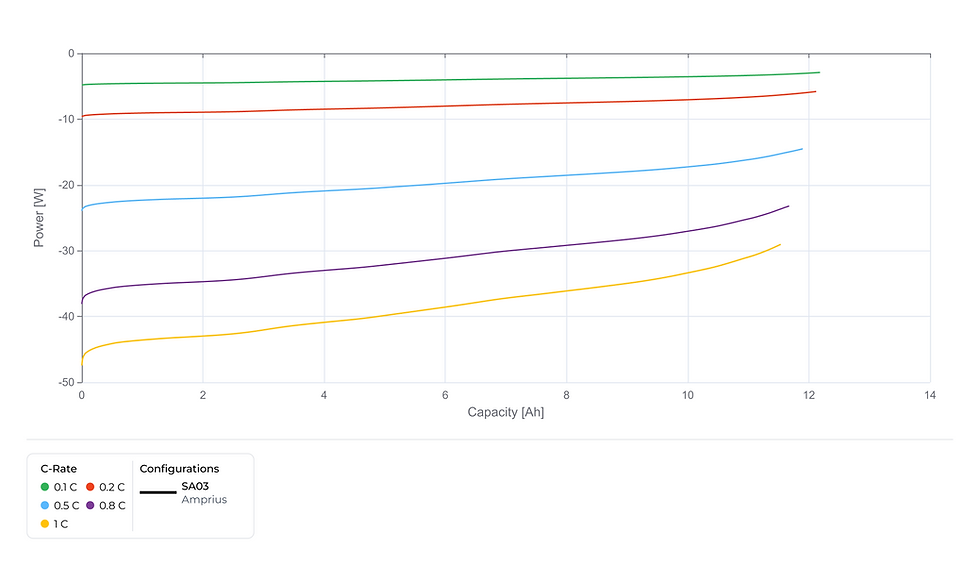
The power response at constant current reflects the declining voltage profile directly. At 0.1C and 0.2C, delivered power is nearly flat across the full discharge, remaining below 10 W with minimal variation. At 0.5C, power starts near 24 W and declines gradually toward end of discharge as voltage falls. At 0.8C and 1C, this decline is more pronounced, with initial power outputs of approximately 36 W and 45 W respectively, tapering through the latter half of discharge and effectively narrowing the usable high-power window as the cell approaches its voltage limit.
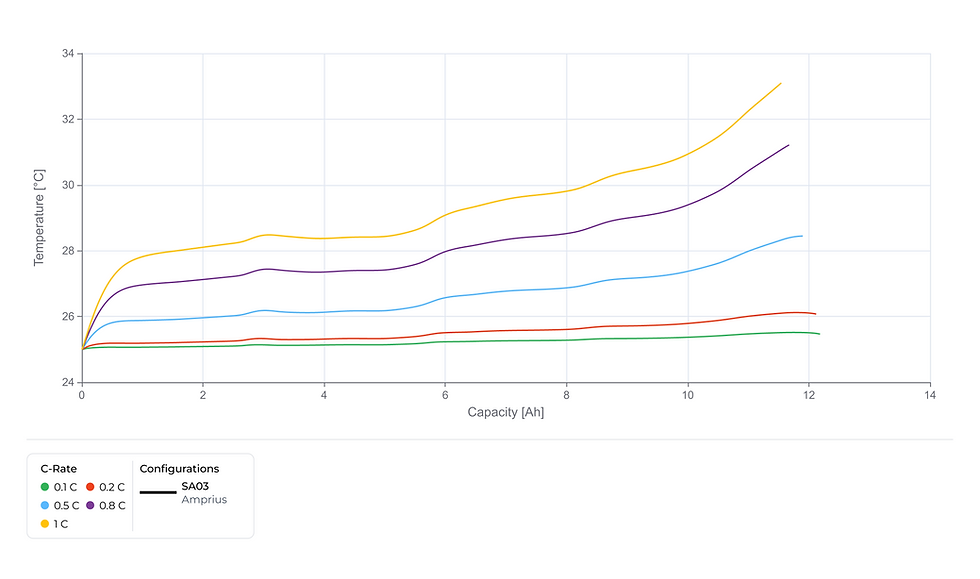
Thermally, the cell is well controlled across the entire simulated range. At 0.1C and 0.2C, temperature remains essentially at ambient throughout discharge, reaching approximately 26°C. At 0.5C, peak temperature rises to approximately 28°C. At 0.8C and 1C, peak temperatures reach approximately 31°C and 33°C respectively, representing a maximum rise of only 8°C above the 25°C starting temperature at the continuous discharge limit. This confirms that heat generation within the rated operating envelope is low and manageable under moderate passive cooling, with no thermal constraints limiting energy delivery across any of the simulated rates.
Summary of Performance Metrics (Simulation)

Simulations were performed at C-rates of 0.1C, 0.2C, 0.5C, 0.8C, and 1C, starting from:
Initial SoC: 100%
Initial Cell Temperature: 25°C
Heat Transfer Coefficient: 50 W/m²K (representing moderate passive cooling from airflow in a ventilated drone enclosure)
Why This Matters for Endurance Drone Design
The simulation results confirm that the SA03 delivers consistent, thermally stable performance across its entire continuous operating range. Capacity retention exceeds 99% at 1C and reaches 105% at 0.1C, demonstrating that the full rated energy is accessible under all load conditions the cell is designed to support. The negligible temperature rise across the range, which peaks at just 33°C at maximum continuous discharge, indicates that thermal management requirements are modest for endurance missions operating within these bounds.
For drone engineers, this characterisation defines a well-behaved and predictable energy source. Pack sizing can be based confidently on the minimum rated capacity of 11.6 Ah, knowing that practical delivery at cruise and hover rates will consistently meet this figure. The low and uniform thermal profile also simplifies pack thermal design, as heat rejection requirements are modest even across full discharge mission durations. The primary design constraint for the SA03 is therefore not thermal headroom but rather current capability. Parallelisation strategies should be driven by propulsion power demand relative to the 1C continuous limit, rather than by thermal considerations.
3 Simulation and Mission Performance Analysis
3.1 Amprius SA03 Constant Power Simulation
While constant current testing establishes rate-dependent behaviour across fixed discharge currents, constant power discharge captures a more representative operating condition for drone propulsion systems, where motor controllers draw current dynamically to maintain thrust as cell voltage declines during discharge. This amplifies the effects of internal resistance and heat generation toward end of discharge, providing a clearer view of practical operating limits under application-representative loading. To evaluate this behaviour, the SA03 was simulated at 5 W, 10 W, 20 W, 30 W, and 40 W.

The voltage response closely mirrors the pattern observed in constant current testing. Curves remain well grouped across all five power levels, with separation increasing progressively at higher loads but remaining modest throughout the discharge window. At 5 W and 10 W, voltage is high and stable across the majority of discharge, with near-full capacity delivered. As power increases to 20 W, 30 W, and 40 W, polarisation becomes more noticeable, but the curves continue to track closely, reflecting the low internal resistance of the cell even under elevated demand. Discharge terminates progressively earlier at higher power levels, driven by the rising current required to sustain constant output as voltage declines toward end of discharge.
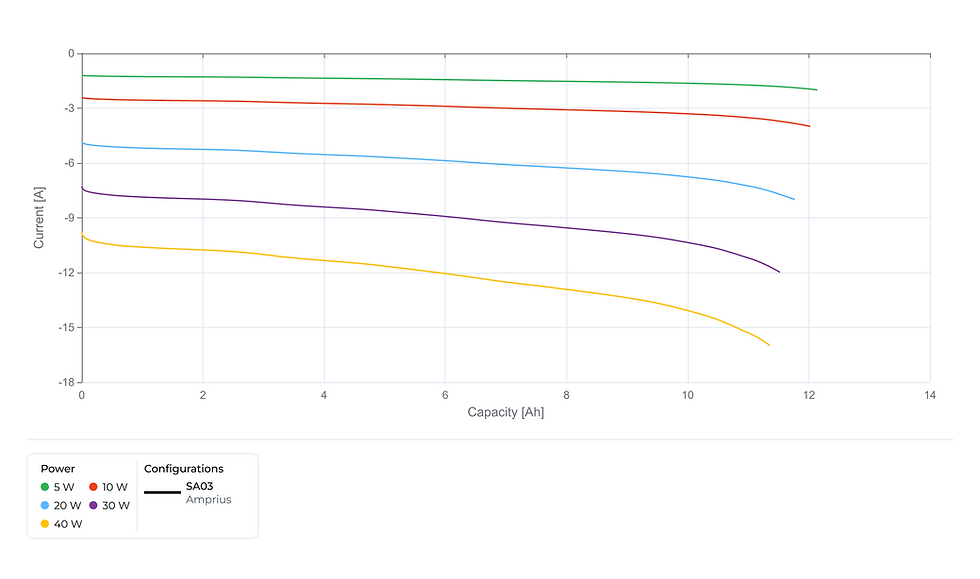
The current response illustrates an important characteristic of constant power operation. Unlike fixed current discharge, current rises dynamically throughout discharge as voltage falls, intensifying electrical stress toward end of discharge. At 5 W and 10 W, peak currents remain at approximately 2 A and 4 A respectively, well within the continuous discharge rating throughout the full discharge window. At 20 W, peak current reaches approximately 8 A, remaining below the 11.6 A continuous limit. At 30 W and 40 W, peak currents rise to approximately 12 A and 16 A respectively toward end of discharge, reflecting the increasing current demand required to sustain constant power output as cell voltage declines. This behaviour is not captured in fixed-current testing and is particularly relevant for propulsion-driven applications.

Thermally, the cell remains well controlled across the full simulated power range. At 5 W and 10 W, peak temperatures reach approximately 26°C and 27°C respectively, representing negligible rise above ambient. At 20 W, peak temperature reaches approximately 30°C. At 30 W, the cell reaches approximately 33°C, consistent with the equivalent 1C constant current result. At 40 W, peak temperature reaches 36°C, with a steeper rise visible in the final 2 Ah as current ramps above the continuous rating. While this remains well within the manufacturer's ambient discharge limit, the accelerating thermal rise at end of discharge at 40 W reinforces the case for SOC-based discharge limits in thermally constrained pack designs.
Summary of Performance Metrics (Simulation)
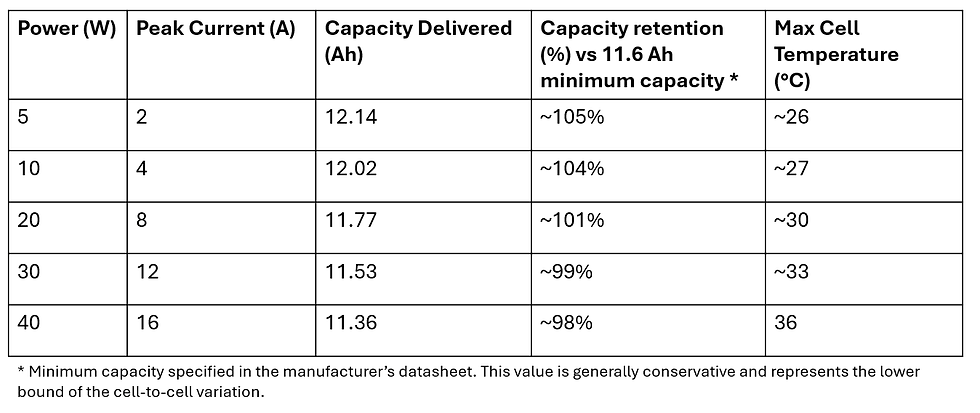
Simulations were performed at power levels of 5 W, 10 W, 20 W, 30 W, and 40 W, starting from:
Initial SoC: 100%
Initial Cell Temperature: 25°C
Heat Transfer Coefficient: 50 W/m²·K (representing moderate passive cooling from airflow in motion in ventilated drone enclosure)
Why This Matters for Endurance Drone Design
Drone propulsion systems operate against power and thrust targets rather than fixed currents, making constant power simulation the more application-relevant characterisation for endurance applications. The results show that the SA03 maintains strong capacity retention and controlled thermal behaviour across the full simulated power range, with capacity remaining at or above 98% even at 40 W. For endurance missions where sustained cruise and hover power demands fall within the 5 W to 20 W per-cell range, the cell delivers near-full energy with minimal thermal burden, confirming its suitability for extended flight duration applications.
At higher power levels, the rising current profile toward end of discharge is the primary design consideration. Engineers should define minimum SOC operating limits to prevent per-cell current from exceeding the continuous rating, or configure pack parallelisation to distribute load and maintain current within rated bounds across the full discharge window. Within these constraints, the SA03 offers a well-characterised and thermally stable energy source for endurance-focused multirotor platforms. Rather than relying solely on static datasheet ratings, simulation clarifies how voltage polarisation and rising current demand shape usable capacity in real mission conditions, enabling more informed decisions around pack sizing, parallelisation, and cooling strategy.
3.2 Amprius SA03 Mission Profile Pack Simulation
While constant current and constant power testing define cell-level capability under controlled steady-state conditions, real drone systems operate under highly dynamic load profiles. Thrust demand varies continuously across flight phases including take-off, climb, cruise, hover, and descent, producing rapid current transients and fluctuating thermal stress that cannot be assessed through fixed-rate testing alone. To evaluate pack-level behaviour under representative endurance loading, a 12s4p SA03 configuration was simulated in the Voltt using a drone endurance duty cycle with sustained mid-power phases and periodic high-power transients.
The mission profile represents a quadcopter endurance scenario, with extended hover and cruise phases and reduced peak transients. The duty cycle was scaled to 80% of the original aero-quad profile to reflect endurance-optimised operation rather than aggressive manoeuvre loading. The cycle was repeated twice to represent two consecutive mission segments within a single discharge, resulting in a total simulated mission duration of approximately 55 minutes.
The configured battery pack delivers:
Pack configuration: 12s4p
Nominal voltage: 12 × 3.40 V = 40.8 V
Capacity: 4 × 11.60 Ah = 46.4 Ah
Total energy: ~1893 Wh
Estimated pack mass: 48 × 104g = ~4.99 kg
Simulation conditions assumed:
Initial SoC: 95%
Initial cell temperature: 25°C
Ambient temperature: 20°C
Heat transfer coefficient: 15 W/m²K (natural convection in an enclosed drone compartment)
Voltage cut-off: 2.5 V per cell
Thermal cut-off: 80°C

Pack voltage declines gradually from approximately 47.7 V at the start of the mission to a minimum of approximately 36 V near the end of the cycle. Voltage recovery is visible during low-load segments. No abrupt voltage collapse or instability is observed during peak thrust events, indicating that the pack maintains controlled discharge behaviour across the full dynamic load range.
The simulated mission produces a peak pack power of approximately 3.23 kW, with an average discharge power of 1.47 kW across the cycle. Peak current reaches approximately 78.6 A, corresponding to 19.65 A per cell, while average current remains around 35 A (8.78 A per cell), reflecting the predominance of sustained mid-power hover phases rather than continuous high-thrust demand. Across the approximately 3300 s mission, the pack delivers 1367 Wh, corresponding to a 70.5% SoC reduction and finishing at 24.5% SoC. The completion of two full duty cycle repetitions within a single discharge confirms that the pack comfortably supports multiple endurance mission segments while retaining meaningful reserve capacity.
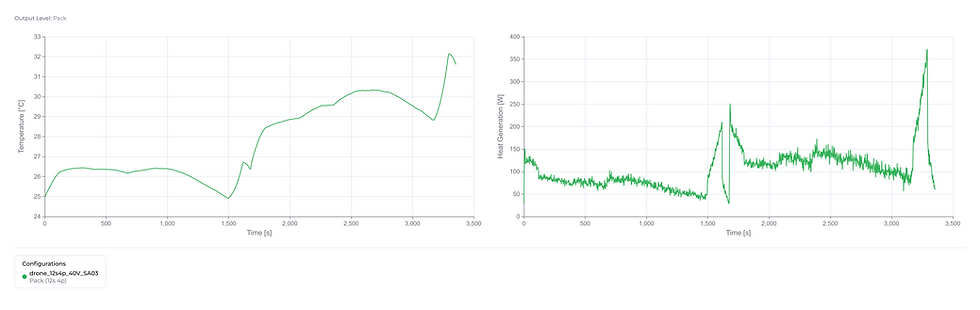
Thermally, the pack remains well controlled throughout the simulated mission. Cell temperature rises from 25°C to a peak of approximately 32.1°C, representing a modest 6.6°C increase over the full cycle. Average heat generation is approximately 105 W at pack level, with short transient peaks reaching approximately 376 W during brief high-thrust segments. Despite these spikes, heat generation does not accumulate into sustained thermal stress, and the temperature profile shows no progressive thermal trajectory toward cut-off thresholds. Under the assumed natural convection cooling environment representative of an enclosed drone battery compartment, the pack remains well below the 80°C thermal cut-off, providing substantial thermal headroom for endurance-style missions.
Why This Matters for Drone Design
The drive cycle simulation confirms that the SA03, configured in a 12s4p architecture, is well suited to extended endurance drone missions. Voltage remains stable under dynamic loading, average per-cell current stays within the continuous rating across the majority of the mission, and thermal behaviour is controlled even under modest natural convection cooling. The 24.5% SoC remaining at mission completion represents a meaningful energy reserve, providing a more complete picture of the cell's transient capability beyond what the datasheet alone can reveal.
For drone engineers, these results translate cell-level characterisation into pack-level mission confidence. The simulation captures voltage recovery between demand phases, cumulative thermal rise under realistic cooling assumptions, and the relationship between transient current peaks and sustained average load, none of which are visible from static datasheet specifications alone. This level of insight supports informed decisions on pack sizing, parallelisation strategy, and thermal architecture before committing to hardware integration.
3.3 Amprius SA03 Pulse Power Capability Mapping
While constant power simulations define sustained operating limits, endurance drone missions also involve short-duration power bursts above continuous ratings, such as during rapid climb, wind gust response, or evasive manoeuvres. Pulse power capability mapping evaluates how much instantaneous power the SA03 can deliver across the full range of state of charge and temperature, providing a more complete picture of the cell's transient capability beyond what datasheet can reveal alone.
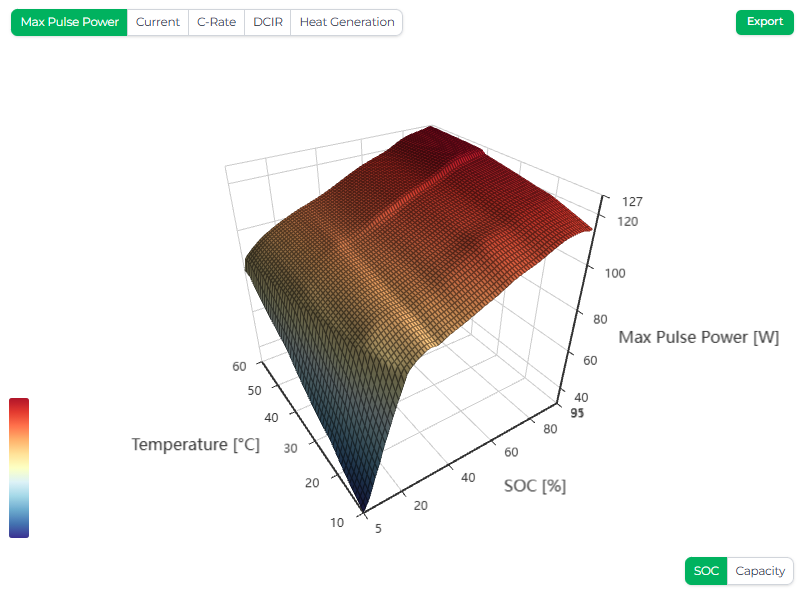
Pulse discharge simulations were performed under the following conditions:
SOC range: 5% to 95%
Temperature range: 10 °C to 60 °C
Pulse duration: 30 s (discharge)
Minimum cell voltage: 2.5 V
Maximum cell temperature: 80 °C
Maximum C-rate: 10C
Ambient temperature: 25 °C
Heat transfer coefficient: 50 W/m²K
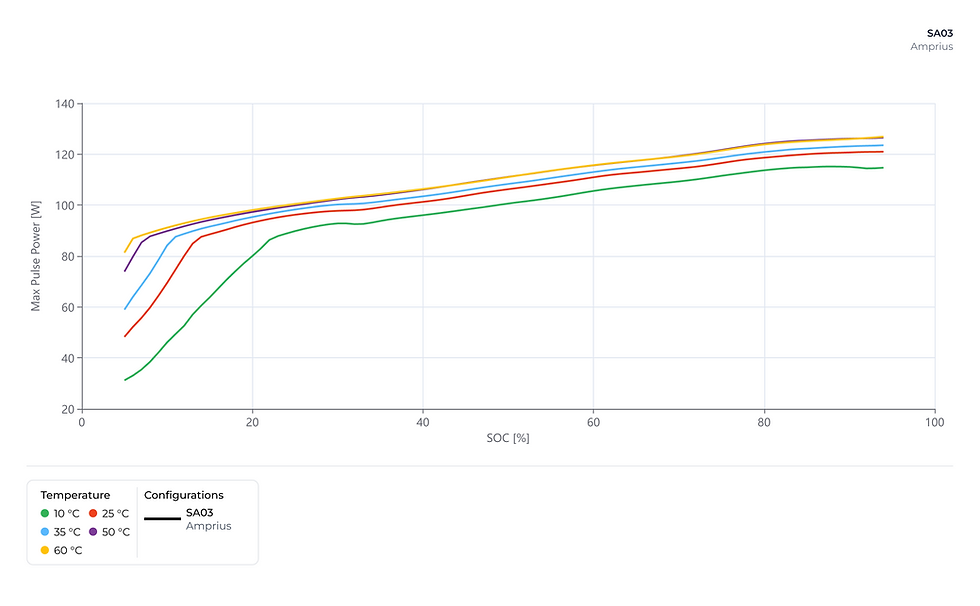
Figure 3.3.2 Maximum pulse power of the Amprius SA03 plotted against SOC at 10°C, 25°C, 35°C, 50°C, and 60°C, highlighting the steep SOC knee region below 20% and the convergence of temperature curves above 40% SOC.
The results show that maximum pulse power scales strongly with SOC across all operating temperatures. Below approximately 20% SOC, pulse capability drops sharply, driven by elevated internal resistance and the reduced voltage headroom available to sustain a 30-second pulse above the 2.5 V cut-off. Above approximately 40% SOC, pulse capability stabilises, with all five isotherms tracking closely between approximately 100 W and 128 W across the mid-to-high SOC region. At high SOC and elevated temperature, peak pulse power approaches approximately 127 W per cell, at which point the 3C C-rate constraint becomes the binding limit rather than voltage or thermal boundaries. This confirms that within the mid-to-high SOC operating window, the SA03 can reliably deliver short-duration thrust bursts at or near its pulse rating.
Temperature has a clear and measurable influence on pulse capability, particularly at low SOC. At 5% SOC and 10°C, maximum pulse power is limited to approximately 32 W, rising to approximately 83 W at the same SOC but at 60°C, a difference of nearly 50 W attributable to temperature alone. This reflects the strong influence of internal resistance on transient capability under cold and depleted conditions. At moderate operating temperatures of 25°C to 35°C and SOC levels above 40%, the temperature curves converge and sensitivity reduces significantly, with performance differences between isotherms becoming small across the mid-to-high SOC window. Practical operation at elevated temperatures increases pulse capability further, though long-term thermal and ageing effects should also be considered in system-level design.
Why This Matters
For endurance drone platforms, pulse power mapping defines the transient capability envelope across the full discharge window and highlights the SOC regions where performance margin is greatest. The steep drop in pulse capability below 20% SOC is a practically important constraint. Engineers should define a minimum operational SOC threshold that ensures sufficient pulse headroom remains available for climb and manoeuvre phases throughout the mission. Operating consistently above 20% SOC preserves near-peak transient capability and avoids the region where both low SOC and low temperature combine to significantly limit available power.
At moderate operating temperatures and SOC levels above 40%, the SA03 demonstrates stable and predictable transient response, supporting burst demands up to the 3C pulse limit without voltage or thermal cut-off. This mapping bridges the gap between continuous ratings and real flight behaviour, enabling engineers to define safe burst-power limits, identify minimum operational SOC reserves, and size packs to maintain adequate pulse margin across the full mission duration.
5 Engineering insights and conclusion
The simulated results show that the Amprius SA03 combines high specific energy with stable electrical and thermal behaviour across steady-state, sustained, and transient loading conditions. Through constant current, constant power, pulse mapping, and dynamic drone duty cycle simulations, the cell's behaviour has been defined from laboratory-scale characterisation through to pack-level mission performance.
At cell level, the SA03 demonstrates strong capacity utilisation at low-to-moderate discharge rates, with voltage polarisation increasing gradually as current demand rises. Thermal response scales predictably with load, remaining well controlled across the full continuous operating range, with a peak temperature of only 33°C at 1C under moderate passive cooling. Pulse mapping indicates that transient power capability is strongest at moderate-to-high SOC, with pulse power declining progressively as SOC decreases. This behaviour is consistent with an energy-optimised cell design where usable energy and voltage stability are prioritised over sustained high burst power.
Constant power simulation reinforces this characterisation. Capacity retention remains at or above 98% across the full simulated power range of 5 W to 40 W. At power levels of 30 W and 40 W per cell, current rises above the continuous discharge rating toward end of discharge as voltage declines to sustain constant output. The primary design boundary for the SA03 is current capability rather than thermal headroom, and pack architecture decisions should reflect this accordingly.
At pack level, the simulated 12s4p drone configuration maintains stable voltage behaviour during dynamic propulsion loads while remaining well within thermal limits under realistic natural convection cooling assumptions. Across an approximately 55-minute mission window, the pack delivers 1367 Wh with a peak cell temperature of 32.1°C and a total temperature rise of only 6.6°C, completing the full duty cycle with 24.5% SoC remaining as operational reserve. No voltage or thermal cut-off thresholds are approached at any point during the simulation.
Pulse power mapping defines the transient capability envelope across the discharge window. Above approximately 40% SOC, the SA03 delivers stable pulse power between 100 W and 128 W per cell regardless of operating temperature, with the 3C pulse limit as the binding constraint. Below 20% SOC, pulse capability decreases sharply and becomes increasingly temperature-sensitive. Engineers should define a minimum operational SOC threshold of approximately 20% to preserve adequate transient capability for climb and manoeuvre phases throughout the mission.
Together, these results define the practical operating envelope of the SA03. Beyond static datasheet specifications, dynamic simulation clarifies:
Usable energy under mission-representative load conditions
Continuous and transient power capability across the discharge window
SOC-dependent performance margins
Thermal behaviour under realistic cooling conditions
By linking validated laboratory data to system-level modelling, engineers can reduce uncertainty in cell selection and pack sizing, optimise parallelisation and cooling strategies, and design propulsion systems against real mission power demands rather than nominal specifications. The Voltt enables this transition from datasheet evaluation to mission-level validation, allowing engineers to explore performance trade-offs early and make informed, data-driven battery design decisions with confidence.
Frequently Asked Questions
What is the energy density of the Amprius SA03 and is it suitable for long-endurance drones?
The Amprius SA03 delivers a minimum gravimetric energy density of 379 Wh/kg based on a maximum cell mass of 104 g, with a manufacturer nominal figure of 400 Wh/kg and a volumetric energy density of 872 Wh/L. These figures place the SA03 firmly in the high-energy region of the lithium-ion cell landscape, making it well suited to endurance drone applications where flight duration and payload efficiency are the primary design priorities. The cell's 1C continuous discharge rating reinforces this positioning: it is optimised for sustained energy delivery at moderate load rather than aggressive high-rate propulsion.
How long can an Amprius SA03 battery pack power a drone?
A 12s4p SA03 pack, with a nominal voltage of 40.8 V, total capacity of 46.4 Ah, and total energy of approximately 1,893 Wh, sustains approximately 55 minutes of endurance drone operation across a duty cycle including cruise, hover, and periodic high-power transients. Across this mission the pack delivers 1,367 Wh, finishing at 24.5% state of charge from a starting point of 95%, and reaching a peak cell temperature of just 32.1°C. The completion of two consecutive full duty cycle repetitions within a single discharge confirms the pack comfortably supports multiple endurance mission segments while retaining meaningful reserve capacity.
How does the Amprius SA03 perform at high discharge rates?
The SA03 maintains strong capacity retention across its full continuous operating range. At 0.1C it delivers 12.18 Ah (105% of the 11.6 Ah minimum specification), and at its continuous discharge limit of 1C it still delivers 11.54 Ah (99% retention). Voltage curves remain closely grouped across all rates up to 1C, with polarisation modest even at maximum continuous current. Peak cell temperature at 1C reaches only 33°C under moderate passive cooling, confirming that heat generation within the rated operating envelope is low and does not constrain accessible energy.
What peak power can the Amprius SA03 deliver for drone manoeuvres?
Pulse power mapping across state of charge and temperature shows the SA03 delivers stable transient power between 100 W and 128 W per cell in the 40% to 95% SOC window, at which point the 3C pulse limit is the binding constraint rather than voltage or thermal cut-off. Below 20% SOC, pulse capability drops sharply and becomes more sensitive to temperature, falling as low as 32 W per cell at 5% SOC and 10°C. Engineers should define a minimum operational SOC of approximately 20% to preserve adequate burst power for climb, gust response, and manoeuvre phases throughout the mission.
What happens to the Amprius SA03 thermally under a drone duty cycle?
Under a simulated endurance drone duty cycle with natural convection cooling representative of an enclosed battery compartment, peak cell temperature reaches 32.1°C, a total rise of just 6.6°C from the 25°C start condition. Average pack heat generation is approximately 105 W, with short transient peaks reaching approximately 376 W during high-thrust segments. These spikes do not accumulate into sustained thermal stress and the pack remains far below the 80°C thermal cut-off throughout the mission. The primary design constraint for the SA03 is current capability relative to the 1C continuous rating, not thermal headroom.
How does constant power discharge affect the Amprius SA03 in drone propulsion?
Drone motor controllers draw current dynamically to maintain thrust as cell voltage declines, making constant power discharge more representative of real propulsion loading than fixed-rate testing. Simulation at 5 W to 40 W per cell shows the SA03 retains at least 98% of rated capacity across the full range. At 30 W and 40 W, current rises above the 11.6 A continuous rating in the final discharge phase as voltage falls, reaching approximately 12 A and 16 A respectively. Engineers should define SOC-based discharge limits or configure pack parallelisation to keep per-cell current within the continuous rating across the full mission window, rather than relying on fixed current limits derived from datasheet values alone.


