
Cylindrical 21700 High-Power Cell
EGI Battery 21700-4.5Ah
High-power cylindrical 21700 cell delivering 4.4 Ah capacity with 230 Wh/kg energy density and 60 A maximum discharge rate.
Overview
The EGI Battery INR21700-4.5Ah is a high-power Li-ion cylindrical 21700 cell designed for applications that demand sustained high current and high energy density. With the manufacturer based in united states, this cylindrical 21700 cell delivers 4.4 Ah capacity and 15.84 Wh of energy at a nominal voltage of 3.6 V, with a maximum continuous discharge capability of 60 A, making it well suited to high-power systems operating under aggressive load profiles.
Key Features
Extremely high discharge rate: 60 A continuous (13.6 C)
Energy density: 230 Wh/kg
Power density: 3130 W/kg
Applications: aviation, motorsports, e-mobility

Technical Specifications from the Manufacturer
Parameter
Manufacturer
EGI Battery
Model
INR21700-4.5Ah
Type
Li-ion
Form factor
Cylindrical 21700
Country of origin
United States
Release year
2025
Nominal voltage
3.6
Energy capacity [Wh]
15.84
Capacity [Ah]
4.4
Gravimetric energy density [Wh/kg]
230
Gravimetric power density [W/kg]
3130
Max continuous discharge [A]
60
Volume [cm³]
25.57
Mass [g]
69
Positive electrode (cathode)
Ni-based
Negative electrode (anode)
Graphite/Si additive
Value
Applications & Use‑Cases
The EGI Battery 4.5Ah is well suited to the following applications due to its cylindrical 21700 and high power performance.
Aviation: Requires high specific energy for extended flight duration, high power-to-weight ratio for climb performance, and reliable operation across wide temperature ranges at altitude.
Motorsports: Demands sustained high discharge under competitive load profiles, rapid transient response for acceleration, and thermal stability to maintain performance during race conditions.
E-Mobility: Requires balanced energy and power density for range and acceleration, high cycle life for daily use, and robust calendar life to ensure long-term reliability.
General Applications: Suitable for applications requiring reliable lithium-ion performance with proven cycle life, consistent capacity delivery, and operational safety across diverse use cases.
.jpg)
Performance & Model Data
Below are modelled performance metrics for the EGI Battery 4.5Ah across key indicators, including constant current behaviour, rate capability, temperature dependence, and available power under representative drive cycle conditions.
Constant Current Voltage
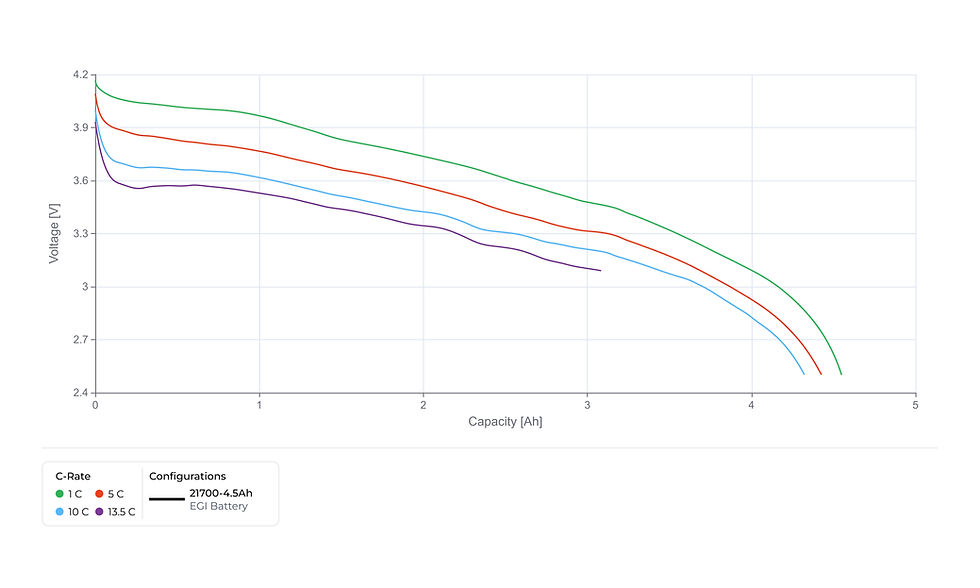
The EGI Battery 4.5Ah constant-current plots reveal voltage behaviour under steady loads, ideal for analysing efficiency.
Constant Current Temperature

The EGI Battery 4.5Ah constant-current plots reveal temperature behaviour under steady loads, ideal for analysing thermal response.
Pulse Power Behaviour
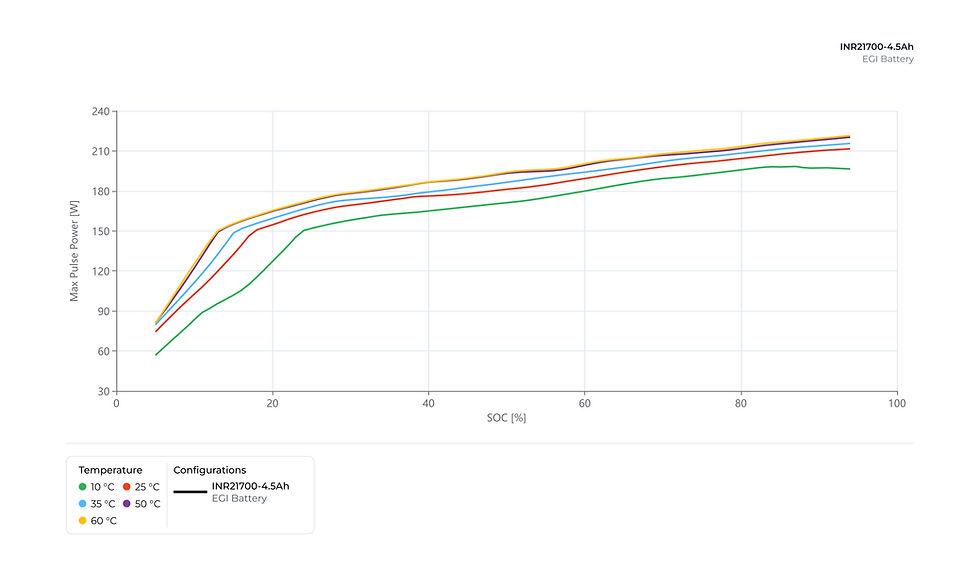
The EGI Battery 4.5Ah pulse power map evaluates short-duration load responses, allowing engineers to determine the maximum available power as a function of state of charge and temperature.
Dynamic Profile Response
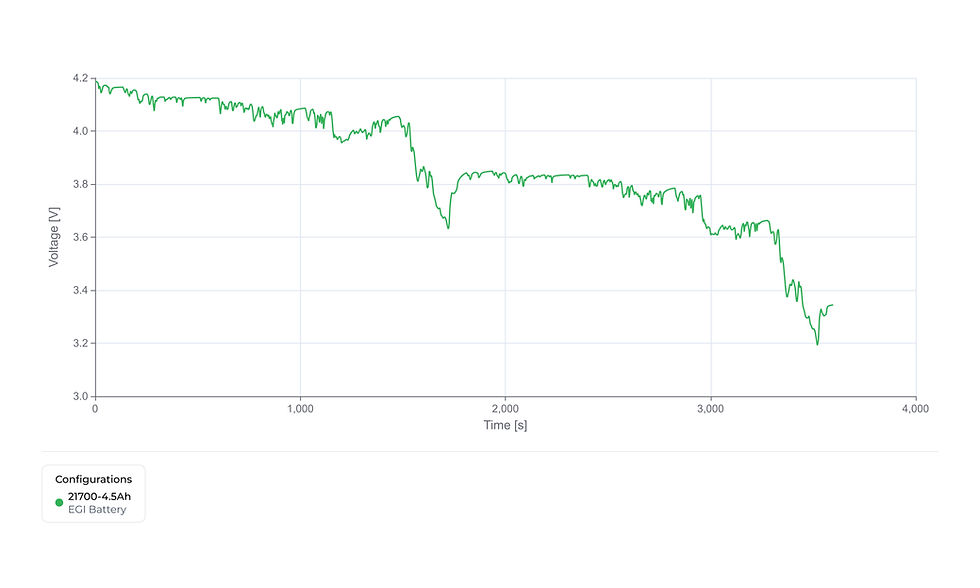
The EGI Battery 4.5Ah mission-profile plots simulate real-world duty cycles, showing how the cell manages dynamic power demands and temperature changes.
.png)
Case Studies
See how we helped McMurtry reduce cell evaluation time by 70% through data driven testing and modelling.

Motorsports
McMurtry Automotive: Faster cell evaluation
McMurtry Automotive used The Voltt and validated cell models to evaluate the transition from the Molicel P45B to P50B during early pack concept development.
Side by side modelling enabled rapid comparison of electrical and thermal behaviour, avoiding lengthy physical test campaigns. This approach reduced cell evaluation time by seven months, allowing the team to lock in cell selection and pack assumptions earlier while lowering technical risk and accelerating vehicle development.
Comparison with Related Cells
Compare the EGI Battery 21700-4.5Ah with similar Cylindrical 21700 cells offering comparable capacity and performance characteristics.
Model
Capacity
Max Discharge
Typical Use
Access Cell Data
Manufacturer Background
EGI Battery
EGI Battery is an American high-performance battery manufacturer
EGI Battery manufactures advanced lithium-ion cells for electric mobility and industrial applications, with a focus on 21700 cylindrical format technology. Based in China, EGI develops battery solutions emphasizing thermal stability and safety characteristics for demanding automotive environments. Their cell chemistry incorporates modern cathode materials designed to optimize energy density while maintaining robust cycle life performance. EGI's manufacturing capabilities serve both domestic Chinese markets and international export customers seeking reliable battery cell suppliers. The company's quality management systems and testing protocols ensure consistent cell performance across production batches. As electric vehicle adoption accelerates globally, EGI positions itself as a competitive alternative in the cylindrical battery cell market.
Frequently Asked Questions
What is the capacity and voltage of the EGI Battery 21700-4.5Ah?
The EGI Battery 21700-4.5Ah has a nominal capacity of 4.4 Ah and a nominal voltage of 3.6 V, providing 15.8 Wh of energy per cell.
What is the maximum continuous discharge capability of the EGI Battery 21700-4.5Ah?
The EGI Battery 21700-4.5Ah supports continuous discharge rates up to 60 A, delivering exceptional power density of 3,130 W/kg.
How much does the EGI Battery 21700-4.5Ah weigh and what is its volume?
The cell has a mass of 69 g and a volume of 25.57 cm³.
In which industries is the EGI Battery 21700-4.5Ah commonly used?
The EGI Battery 21700-4.5Ah is used across eVTOL, motorsports, drones, and e-mobility, applications that demand both high energy and power density.
What is The Voltt and how does it accelerate cell evaluation?
The Voltt is About Energy's digital cell simulation platform that models electrochemical and thermal performance, reducing evaluation time by up to 70% compared to laboratory testing.
What data can be extracted using The Voltt?
Engineers can simulate and visualise voltage, temperature, and power responses under constant-current or mission-profile conditions, generating detailed discharge plots to support accurate cell comparison and validation.


